

Yes, a mattress protector for children makes sense in most cases. Whether it's a crib, a child's bed, or a youth bed: children spill, sweat, and diapers leak. An unprotected child's mattress absorbs moisture, forms stains, and becomes a breeding ground for dust mites. With the right protector, the mattress remains hygienically clean, dries quickly, and lasts significantly longer.
Why do children need a mattress protector?
Children's mattresses are exposed to daily stresses that adult mattresses rarely experience. Night sweats, leaking diapers, milk residue from breastfeeding in bed: all of this penetrates the mattress core if there's no protection.
3 specific reasons why protection pays off:
- Hygiene: Moisture in the mattress core promotes mold and mite growth. Dust mites multiply particularly quickly in damp, warm environments.
- Durability: A good child's mattress costs between 80 and 250 Euros. A protector extends its lifespan by several years.
- Allergy risk: Children with sensitive skin or respiratory allergies demonstrably sleep better on a mite-protected surface.
Do you need a mattress protector for a crib?
Yes, especially in a crib, a mattress protector for babies is indispensable. Newborns and infants need up to 18 hours of sleep per day. During this time, the baby sweats, spits up, and the diaper leaks more often than desired.
Important: For cribs, there's a safety rule that many parents don't know. For newborns up to 12 months, the protector must be exclusively breathable. Waterproof foil pads can restrict air circulation and are not suitable for infants. From toddler age (from approx. 12 to 18 months), waterproof models can be used without hesitation.
Standard sizes for cribs in Germany:
- 60 x 120 cm (most common crib size)
- 70 x 140 cm (transition size for toddlers)
- 40 x 90 cm (travel cot, stroller, bassinet)
What types of mattress protectors are available for children?
There are 3 main types that differ in material and protective function:
1. Breathable mattress protector
Made of jersey or terry cloth without a waterproof membrane. Ideal for newborns as it allows full air circulation. Light moisture protection due to the fabric's absorbency. Washable at 60 degrees Celsius.
2. Waterproof mattress protector (wetness protection)
Contains a PU membrane (polyurethane) or similar protective layer that completely repels liquids. Wetness protection for the crib is particularly practical during the potty training phase (approx. 18 to 36 months) and for children who are not yet dry at night. High-quality models combine waterproofing with breathability through a microporous membrane.
3. Molton protector and mattress cover
Made of brushed cotton (molton). A classic mattress cover of this type is soft, absorbent, and very pleasant on the skin. It does not offer complete wetness protection but is excellent as a second layer under the bed sheet to absorb sweat. Care instructions: washable at 60 degrees Celsius.
Mattress protector on the slatted frame: Is that necessary?
No, a mattress protector on the slatted frame is not necessary. The protector is attached to the mattress, not underneath. The waterproof protective layer sits between the mattress and the bed sheet. A protector under the mattress blocks the ventilation of the slatted frame and promotes exactly what should be prevented: moisture build-up.
Correct order in the child's bed:
- Slatted frame or bed frame
- Child's mattress
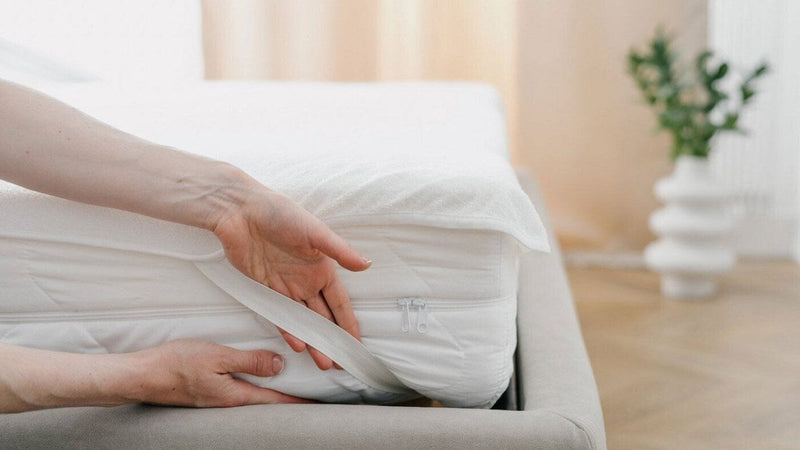
- Mattress protector (on the mattress, with elastic band or all-around elastic)
- Bed sheet or fitted sheet
What size mattress protector do children need?
The protector must fit the mattress exactly. A model that is too large or too small will slip, form creases, and can pose a safety risk. These 5 sizes cover most German children's beds:
- 40 x 90 cm: Travel cot, stroller, baby bath
- 60 x 120 cm: Standard crib (most common size in Germany)
- 70 x 140 cm: Transition bed for toddlers
- 90 x 200 cm: Youth bed
- 140 x 200 cm: Large child's bed or parents' bed for falling asleep with a child
What to look for when buying a mattress protector?
These 4 criteria are crucial:
- OEKO-TEX Standard 100 Certification: Guarantees that the protector is free of harmful substances and harmless to health. Always pay attention to this seal, especially for babies.
- Fit and elastic: All-around elastic or elastic band must securely encompass the mattress. Protectors that slip are dangerous, especially for babies.
- Washability: At least 60 degrees Celsius washing temperature, preferably 90 degrees, to reliably kill mites and germs. Tumble dryer-suitable models are a plus.
- Quiet PU membrane: Cheap protectors with plastic foil rustle with every movement. This disturbs sleep. High-quality models use silent, woven PU membranes.
When is a mattress protector not useful?
A protector is less useful or even counterproductive in 3 cases:
- Waterproof protector for newborns: Completely waterproof models with a foil layer can restrict the breathing air around the mattress for infants. For newborns, always choose exclusively breathable variants.
- Poor fit: A protector that rolls up or slips creates folds and unevenness under the bed sheet. The risk of a baby getting caught underneath is low, but present.
- Inferior material without certification: Protectors without OEKO-TEX or comparable certification can contain formaldehyde or other chemicals. For babies with sensitive skin, this can cause skin irritation.
Proper care of a mattress protector for a child's bed
Improperly cared for protectors quickly lose their function. These 4 care tips ensure long-lasting effectiveness:
- Washing temperature: 60 degrees Celsius is sufficient for normal use. In case of illness of the child or after diarrhea, choose 90 degrees, if the label allows.
- Dryer: Always tumble dry protectors with a PU membrane at a low temperature (gentle drying). High heat permanently destroys the waterproof membrane.
- Frequency: Wash at least every 2 to 4 weeks. Weekly for babies with dust mite allergies.
- Replacement: If seams come open or the protector loses its shape, it must be replaced. A defective protector no longer offers protection.
Frequently asked questions about mattress protectors for children
Do you really need a mattress protector for a crib?
Yes. A baby sleeps up to 18 hours a day. During this time, it sweats, spits up, and the diaper leaks. Without protection, the mattress absorbs moisture, which promotes mites and mold. A mattress protector protects the mattress and ensures a hygienic sleeping environment.
How often should you wash the mattress protector?
Every 2 to 4 weeks at 60 degrees Celsius. In case of allergies or illness of the child, wash weekly. After diarrhea or severe vomiting, wash immediately at 90 degrees if the care label allows.
Is a waterproof mattress protector safe for babies?
For newborns up to 12 months, only use breathable protectors without a foil layer. Waterproof models with a PU membrane are suitable from toddler age (from approx. 12 to 18 months), as soon as the child can move around in bed independently. Pay attention to OEKO-TEX certification.
What size mattress protector is needed for a 60x120 crib?
For a standard crib with a 60 x 120 cm mattress, buy a protector in exactly this size. A protector that is too large will slip and form creases under the sheet, which poses a safety risk.
What is the difference between wetness protection and a mattress protector?
Wetness protection is the umbrella term for all products that keep moisture away from the mattress. A mattress protector can offer wetness protection, but it doesn't have to. Breathable protectors without a PU membrane absorb moisture but allow it to pass through to the mattress in the long run. Real wetness protection completely blocks moisture.
Can you tumble dry the mattress protector?
Only at a low temperature (gentle drying, level 1). High heat permanently destroys the waterproof PU membrane. Protectors without a membrane can usually withstand higher temperatures. Always check the care label.
Do you need a mattress protector on the slatted frame?
No. The mattress protector belongs on the mattress, not underneath. A protector between the slatted frame and the mattress blocks air circulation under the mattress and can cause moisture build-up and mold growth.
Conclusion: A mattress protector for children is worthwhile
A mattress protector for children is not optional equipment, but practical protection that saves costs and improves sleep hygiene. For newborns, exclusively choose breathable models. From toddler age, waterproof protectors can be used. Pay attention to exact size, OEKO-TEX certification, and a quiet membrane.
Terra Beds offers OEKO-TEX certified mattress protectors in common children's bed sizes: Mattress protector 60 x 120 cm and Mattress protector 70 x 140 cm. All models are silent, washable at 60 degrees, and custom-fit for standard German beds.


![Baumwolle vs. Jersey Spannbettlaken – Was ist der Unterschied? [Kompletter Guide]](http://terrabeds.de/cdn/shop/articles/Baumwolle_vs._Jersey_Spannbettlaken_4dc2666d-f04b-4cdf-9929-6b76e46c6ab7.jpg?format=webp&v=1776384143&width=800)

