

Neck pain after waking up is not a coincidence. It is caused by an incorrect sleeping position, an unsuitable mattress or the wrong pillow. Studies show that 70% of people with chronic neck pain have a suboptimal sleeping environment. The solution lies in three factors: head support, spinal alignment and breathable materials.
If you wake up with a stiff neck in the morning, you should first check your pillow and fitted sheet. A slipped sheet changes your sleeping position and strains your cervical spine. Terra Beds fitted sheets made of 100% cotton (160 g/m²) with an all-round elastic band prevent exactly that. They stay in shape and keep the mattress grippy.
Why does neck pain occur at night?
Neck pain is caused by incorrect strain on the cervical spine at night. There are three main causes:
- Pillow too high or too flat – overstretches or bends the neck
- Worn-out mattress – allows shoulders and pelvis to sink in
- Slipping bedding – forces unnatural evasive movements
The cervical spine needs a straight line from head to tailbone when lying on your side. Any deviation tenses muscles such as the levator scapulae or the trapezius muscle.
The optimal sleeping position for neck pain
Side sleeping is the best position for neck pain. In this position, the spine remains straight if the pillow and mattress are chosen correctly.
The second best position is on your back. Here you need a lower pillow that supports the natural cervical lordosis but does not push the head forward.
Stomach sleeping is the worst position. It forces the head to the side (over 40° rotation) and flattens the cervical spine. Avoid this position consistently.
The right pillow for pain-free sleep
A good neck pillow keeps the head and neck at the same height as the thoracic spine. The optimal pillow height is:
- Side sleepers: 10–13 cm (depending on shoulder width)
- Back sleepers: 5–8 cm
- Stomach sleepers: maximum 3 cm or no pillow at all
Orthopaedic pillows with a contour cut (a depression for the head, an elevation for the neck) are ideal. Materials such as memory foam or latex adapt. Avoid overly soft down pillows as they give way too much.
The mattress: support for the entire spine
A medium-firm mattress with point elasticity relieves the neck best. It should yield at the shoulders and hips, but support the neck. Two common mistakes:
- Too soft mattress – pelvis sinks in, head points upwards (overextension)
- Too hard mattress – shoulders are pushed away, spine curves sideways
Test your mattress: Lie on your back. One hand should just fit under the curve of your neck – no more, no less.
How fitted sheets affect neck pain
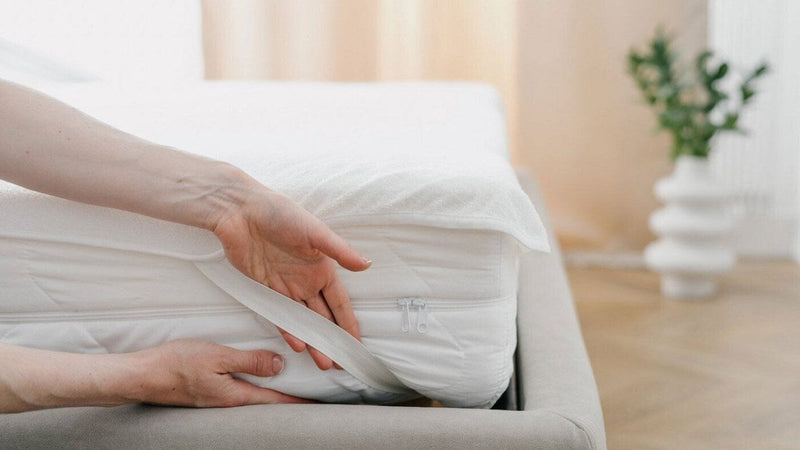
A non-slip fitted sheet maintains the mattress shape and prevents evasive movements. If the sheet slips at night, the friction changes. You unconsciously correct your position, often with jerky head or shoulder movements.
Terra Beds fitted sheets made of 100% cotton with an all-round elastic band offer three advantages:
- Dimensional stability – holds up even after 10 washes
- 160 g/m² – grippy, but not rough
- Base height up to 25 cm – fits box spring beds and toppers
Breathable cotton reduces night sweats. Less moisture means fewer changes in position at night. Every movement less spares the neck.
Materials compared: cotton, microfiber and more
| Material | Grammage/Thread count | Breathability | Friction (non-slip) |
|---|---|---|---|
| Cotton (Terra Beds) | 160 g/m² | High | Medium-high |
| Microfiber | 100–120 g/m² | Low | Low (slippery) |
| Percale cotton | 200 g/m² | Medium | High |
Microfiber generates static electricity and leads to sweating more quickly. Percale is heavier, but less elastic. Terra Beds jersey cotton offers the ideal compromise between grip and freedom of movement.
5 concrete tips against nocturnal neck pain
- Measure your shoulder width (side lying = pillow height = shoulder width minus 2 cm). Example: shoulder width 45 cm → pillow height 10–11 cm
- Change your pillow every 18 months. After 2 years, memory foam loses 30% of its support
- Warm your neck before sleeping (5 minutes red light or cherry stone pillow)
- Use a neck roll made from a towel (diameter 8–10 cm) under the pillow
- Stretch in the morning (chin to chest, then slowly to the right and left collarbone, each side 20 seconds)
The role of OEKO-TEX® in neck pain
OEKO-TEX® Standard 100 certified bedding reduces irritation and nocturnal restlessness. Tested for over 100 harmful substances:
- Pesticides (irritate nerves)
- Formaldehyde (dries out the skin)
- Heavy metals (can increase muscle tension)
All Terra Beds products bear this seal. For allergy sufferers and people with sensitive skin, this is a must, not an option. A chemical smell in a new fitted sheet is a warning sign. Faulty products can cause headaches and neck tension.
How to test your current sleeping equipment
Three simple tests reveal flaws in your bedding:
- Test 1 (Pillow): Lie on your side and have someone take a photo of you from behind. Is the line from your head to your tailbone straight? If your head hangs down → too low. If it points upwards → too high
- Test 2 (Mattress): Lie on your back, hands on your stomach. A second person tries to push three fingers between your neck and the mattress. If the hand fits flat → too hard. If the fist fits → too soft
- Test 3 (Fitted Sheet): Sleep one night without a fitted sheet. Are the pains gone? Then your sheet is too slippery or deforms the mattress
Frequently Asked Questions (FAQs)
Is a neck pillow useful in every sleeping position?
Yes, but with different heights. Side sleepers need a high pillow (10–13 cm), back sleepers a lower one (5–8 cm). Stomach sleepers should use no pillow or a maximum of 3 cm.
Can a new fitted sheet relieve neck pain?
Yes, if the old sheet slips or distorts the mattress. A dimensionally stable cotton sheet (like 160 g/m² from Terra Beds) keeps the sleeping surface constant. You move up to 40% less at night.
How often should I change my pillow?
Every 18 to 24 months. After 2 years, the support capacity is reduced by about 30%. Wash pillows every 3 months at 60°C.
Does heat or cold help with acute neck pain in the morning?
Heat relaxes tense muscles (5–10 minutes). Cold helps with inflammation. Morning pain without swelling → heat.
Which mattress firmness is ideal for neck pain?
H2 (medium) for people up to 80 kg, H3 (firm) for 80–110 kg. For neck pain, usually choose slightly firmer than usual.
Can a too thick fitted sheet be harmful?
Yes, anything over 200 g/m² can change the mattress firmness. 160 g/m² is considered an optimal value.
What to do if neck pain occurs when travelling?
Roll up a towel (approx. 8 cm diameter) and place it in your neck. Alternatively, lie on your back without a pillow and place a towel under your knees.
Which sleep trackers help with neck pain?
Wearables like Fitbit or Apple Watch measure sleeping positions and movements. The goal is fewer than 20 position changes per night.
Should I see a doctor?
Yes, if pain lasts longer than 2 weeks, numbness occurs, or you wake up from it at night.
Does Terra Beds fitted sheet fit every mattress?
Yes, with a base height of up to 25 cm, they fit about 90% of all mattresses. Sizes range from 60×120 cm to 200×200 cm.
Conclusion
Neck pain during sleep is treatable – often without expensive interventions. Start with the pillow (height matching shoulder width), check the mattress, and change the fitted sheet to a dimensionally stable cotton model.
Test each change for 3 nights. Often a small adjustment is enough. If symptoms persist, you should consult a doctor. Your spine will thank you with restful sleep – quiet, deep and without morning stiffness.
Act now: Measure your shoulder width, check your pillow and rely on breathable materials. Terra Beds delivers within 2–4 working days with a 14-day return policy.


![Baumwolle vs. Jersey Spannbettlaken – Was ist der Unterschied? [Kompletter Guide]](http://terrabeds.de/cdn/shop/articles/Baumwolle_vs._Jersey_Spannbettlaken_4dc2666d-f04b-4cdf-9929-6b76e46c6ab7.jpg?format=webp&v=1776384143&width=800)

