The choice of the right cover determines the visual effect, ergonomic comfort, and durability of your pillows. A pillowcase must precisely match the nominal size of the pillow filling in its dimensions to prevent wrinkles or extreme fabric tension. If you have an insert (inner pillow) with dimensions of 40x40 centimeters (cm), this precisely requires a 40x40 cm pillowcase. Deviations will either lead to a slack, unaesthetic appearance or excessive compression of the filling material, which reduces elasticity.
The primary filter for the purchasing decision is the harmony between cover size and pillow firmness. For decorative living areas, however, there is an established manufacturing trick: If you want to achieve a particularly plump, voluminous pillow look on upholstered furniture, choose the pillow filling exactly 5 cm larger than the pillow cover. A 45x45 cm inlay in a 40x40 cm sofa cushion cover generates maximum support volume. For sleeping pillows and ergonomic neck supports, this approach is not advisable, as the biomechanical effect of the filling is lost due to compression pressure.
For informed guidance on Terrabeds.de, this guide structures all established market sizes, material properties, and combination tactics for beds, sofas, and functional pillows.
Pillow Size Chart: The Most Important Measurements at a Glance
The textile industry works with standardized dimensions that differentiate according to the intended use in the sleeping system or living area. The following matrix lists the exact cover sizes for each type of pillow:
|
Pillow Size (cm) |
Exact Cover Size (cm) |
Primary Use / Pillow Type |
Typical Fill Weights & Examples |
|
40 x 40 |
40 x 40 |
Compact sofa cushion, decorative pillow, children's pillow |
200g polyester fiber balls, guest bed accents |
|
45 x 45 |
45 x 45 |
Common comfort size for living landscapes |
Poco pillow 45x45, 4-piece set of pillowcases 45x45 |
|
50 x 50 |
50 x 50 |
Universal size for deep sofas, lounge area |
Sofa cushion 50x50 Ikea, large decorative pillows |
|
40 x 60 |
40 x 60 |
Ergonomic pillow, neck support pillow |
Latex or memory foam inlays, Ikea covers |
|
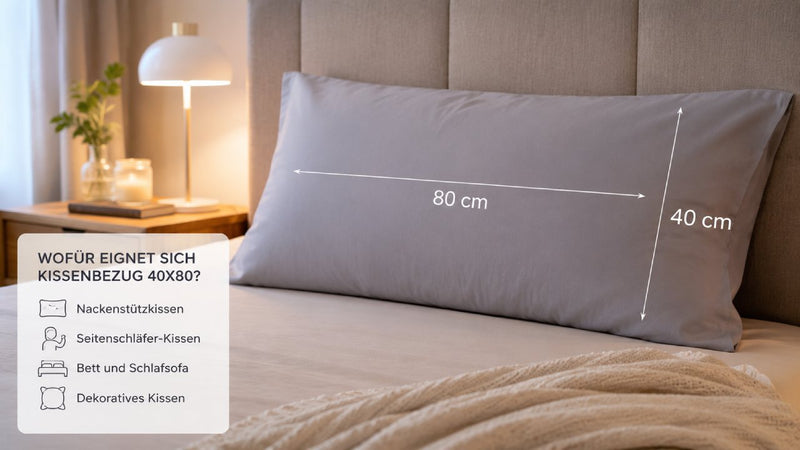
40 x 80 |
40 x 80 |
Modern sleeping pillow (Orthopedic Standard) |
Health sleeping pillow, viscoelastic neck pillows |
|
80 x 80 |
80 x 80 |
Classic German pillow standard size |
800g down-feather filling, traditional beds |
|
65 x 65 |
65 x 65 |
Swiss standard pillow, lounge pillow |
Pillowcase 65x65 Jysk, European special sizes |
Sofa Cushions and Decorative Pillows: Dimensions for the Living Area
In the living room, pillowcase sizes control the visual balance of upholstered furniture. Incorrect proportions reduce the quality of the room's appearance. If you are furnishing a delicate 2-seater sofa, large pillowcases (like 60x60 cm) will seem out of place and confining. Here, compact units like the 40x40 pillowcase or 45x45 cm are the more stable choice.
Large sofa cushions require gradual staggering (layering method). Place a large decorative pillow of 60x60 cm or 50x50 cm as a rear base directly against the sofa back. In front of it, position medium units such as a fancy sofa cushion 50x50 or pillowcases 45x45 in a 4-piece set. The front finish is formed by a functional longitudinal pillow, for example, a pillowcase 35x50 cm or pillowcases 30x60 cm, which serve as lumbar support. This depth effect optimizes seating comfort.
The chosen sofa cushion fabric sustainably influences dimensional stability. Heavy jacquard fabrics, corduroy fabrics, and structured cotton canvas covers tolerate minimal size differences, while thin polyester fabrics quickly stretch or wrinkle unattractively with incorrect filling. Seasonally popular textiles, such as pillowcases for Christmas with Christmas tree motifs, often have rigid appliqués, which is why the standard pillow size must be precisely adhered to here.
Pillows in the Bedroom: Standard Sizes vs. Ergonomics
The choice of pillow size determines the orthopedically correct positioning of the cervical spine (HWS). The traditional standard pillow size deeply rooted in Germany is 80x80 cm. From a sleep biological perspective, this format has disadvantages: the shoulders often rest on the pillow, causing the spine to bend. If you suffer from tension, the ergonomic comfort size 40x80 cm is the more effective alternative. Since this pillow is only half as high, only the head and neck area rest on it, while the shoulder sinks directly into the mattress.
Special sleeping systems require custom-made protective covers. A pillowcase for neck pillows or a pillowcase for neck support pillows usually consists of highly elastic materials such as jersey or interlock knit. These fabrics precisely adapt to the wave-like contours of the foam core without creasing, which could cause pressure points on the face. For international sleeping systems, sizes such as the 65x65 pillowcase or 20x20 pillowcases for small additional pillows are also relevant.
Special Shapes and Specialty Pillows in Focus
In addition to the square and rectangular classics, there are specific functional shapes that require exact covers:
- Neck support pillows: These require elastic covers, often in sizes 40x60 cm or specified directly by the brand manufacturer. A pod pillowcase securely fixes ergonomic cores without slipping.
- Seat cushions: A seat cushion for a chair in 40x40 cm usually has fastening straps. The cover must be extremely abrasion-resistant.
- Round pillows: Round pillowcases require zippers that run over half the circumference to insert the insert without deformation.
Material Science: Which Fabric Serves Which Purpose?
The textile composition determines the microclimate in the bed and the durability on the sofa. Choose the material based on your thermal needs:
- Mako satin & silk: Smooth surface structures reduce friction on skin and hair. They have a cooling effect and are ideal for summer.
- Flannel & fleece: Brushed cotton fabric stores heat efficiently. Perfect for winter sleeping systems.
- Jersey: Knitted fabric with high elasticity. Optimal for wavy neck support pillows, as it is absolutely wrinkle-free.
- Linen & canvas: Robust, breathable natural fibers with a high grip, predestined for heavily used sofa cushions.
Frequently Asked Questions (FAQ)
Which pillowcase fits a 40x80 pillow?
An exactly identical pillowcase measuring 40x80 cm fits this pillow. Do not use larger covers such as 80x80 cm by simply folding them over, as this will create hard fabric bulges that reduce ergonomic sleeping comfort.
Can you put a large pillowcase on a small pillow?
No, putting a large pillowcase on a small pillow is unsuitable. The excess fabric constantly slips, creates annoying wrinkles, and creates a messy appearance in the room.
What is the normal pillow size in Germany?
The traditional standard size for pillows in Germany is 80x80 cm. Modern, health-oriented bed systems are increasingly using the ergonomic alternative size of 40x80 cm.
Which cover is suitable for an orthopedic neck support pillow?
For an orthopedic neck support pillow, a flexible jersey cover measuring 40x60 cm or 40x80 cm fits easily. The material must be highly elastic so that the ergonomic contour of the foam core is transmitted to the body without restriction.
Which pillowcase size should you choose for a plump decorative pillow?
To get a plump decorative pillow, choose the pillowcase exactly 5 cm smaller than the inlay. For example, insert a 45x45 cm filling pillow into a 40x40 cm pillowcase.
How do you correctly measure the size of a pillow?
Lay the pillow flat and measure from outer seam to outer seam along the edges. Do not measure diagonally or when it is fully inflated to avoid measurement errors due to the curvature.
Which type of closure is the most durable for pillowcases?
A concealed sewn-in plastic zipper is the most durable type of closure. It prevents the insert from slipping out and closes flush compared to the classic hotel closure.